Quick Summary: Medwriter vs DeepScribe — Which AI Scribe Is Better for Psychiatry?
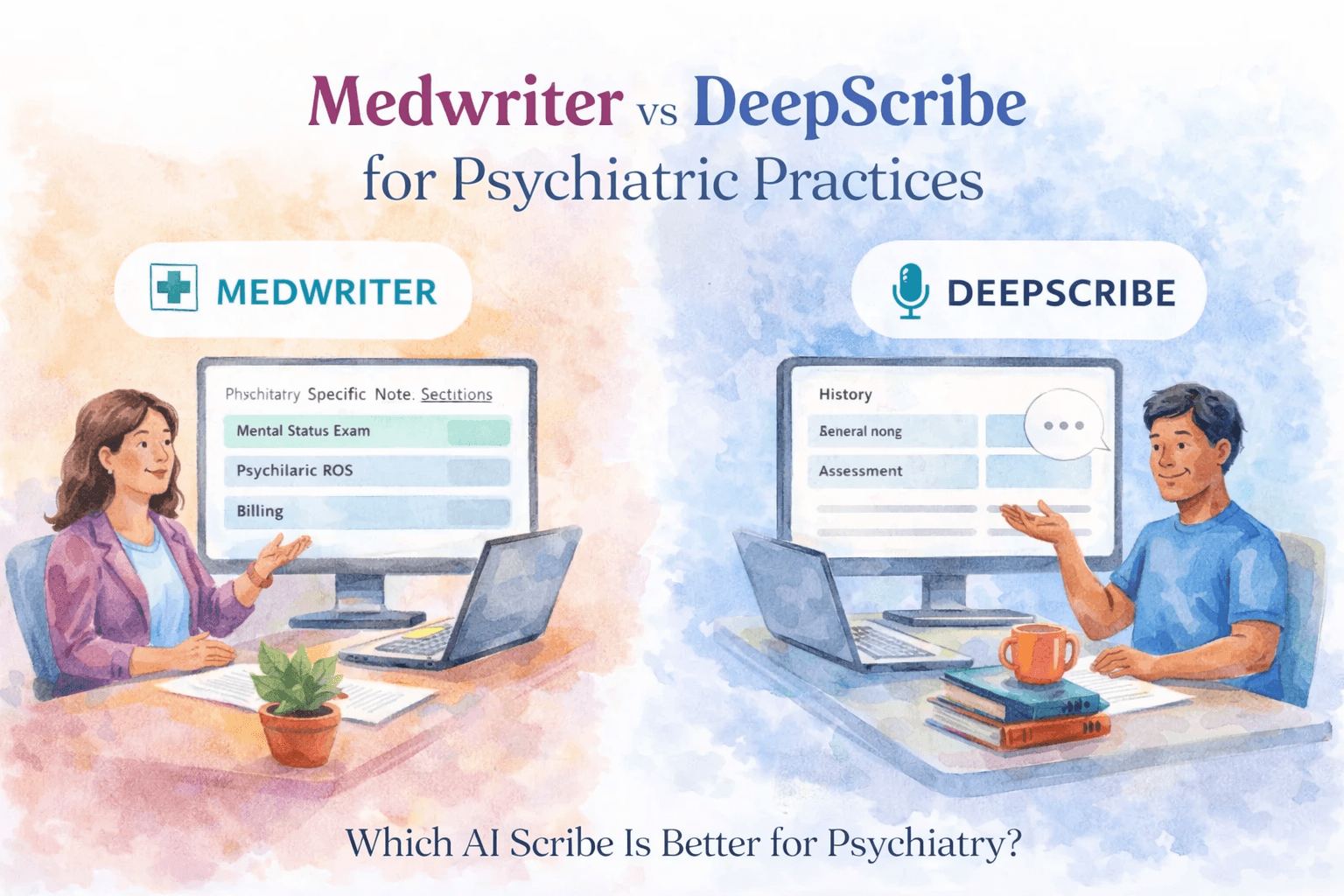
In the Medwriter.ai vs DeepScribe comparison, both platforms offer ambient AI note generation and EHR integration, but they diverge when it comes to psychiatry-specific functionality. Medwriter is purpose-built for psychiatric practice, with dedicated note sections, billing tools, and workflow features designed around how psychiatrists actually work. DeepScribe is a well-regarded general-purpose AI scribe that performs well across many medical specialties but wasn't designed with psychiatry as its primary focus. This article breaks down the key differences so you can make an informed decision for your practice.
Introduction
AI scribes have become a practical solution for the documentation burden in psychiatric practice — but not every platform handles psychiatric workflows equally well. Both Medwriter.ai and DeepScribe are AI-powered tools that listen to clinical encounters and generate structured notes, but when you look closer through the lens of a psychiatric provider, the differences start to matter.
This Medwriter vs DeepScribe comparison walks through the areas that matter most to psychiatrists and PMHNPs: note structure, billing support, treatment planning, prior authorization, and overall workflow fit.
What Is Medwriter?
Medwriter is an AI scribe platform built specifically for psychiatry — not a general-purpose tool adapted for mental health. It includes psychiatry-specific templates with dedicated sections for Mental Status Exams (MSE), Psychiatric Review of Systems, Psychotherapy Add-On documentation, and Psychiatric History. It supports session types common in psychiatric practice, such as medication management and medication management plus psychotherapy.
Beyond note generation, Medwriter.ai offers billing suggestion support with CPT code recommendations, long-term treatment plan drafting with reminders, prior authorization support that flags gaps in payer requirements, chart prep summaries before follow-up visits, real-time session checklists, medical assistant workflows, multi-language support, and additional document generation for items like letters of medical necessity and accommodation letters.
If you're evaluating the best ai scribe for psychiatry, Medwriter’s dedicated solution for psychiatric providers is built specifically around your specialty’s documentation, billing, and workflow needs.
What Is DeepScribe?
DeepScribe is one of the more established AI medical scribes on the market, serving over 1,500 healthcare organizations with a 98.8 KLAS spotlight score. It uses ambient AI to capture patient-provider conversations and generate structured clinical notes, and integrates with major EHR systems like Athena, eClinicalWorks, Epic, and AdvancedMD.
DeepScribe adapts to different specialties and learns from each provider's edits over time, with particularly deep capabilities in oncology and cardiology. It also includes automated E/M coding recommendations. However, it's primarily designed for enterprise and multi-specialty environments — it typically requires a sales consultation, a contract, and coordinated onboarding, which can make it less accessible for solo practitioners or smaller psychiatric practices.

Head-to-Head: Key Comparison Areas
Psychiatry-Specific Documentation
This is where the Medwriter.ai vs DeepScribe gap is most apparent. Medwriter's notes include dedicated sections for MSE, Psychiatric ROS, Psychotherapy Add-On details, and Psychiatric History — the sections psychiatrists and PMHNPs actually look for when reviewing a chart.
DeepScribe generates detailed notes and adapts to specialties over time, but its primary focus areas have been fields like oncology, cardiology, and orthopedics. It doesn't come out of the box with the same psychiatric specificity, which means providers may spend more time editing notes to include the sections and nuances that Medwriter captures automatically.
Billing Support
Medwriter automatically suggests CPT codes based on session content and supports both time-based and E/M-based billing logic — particularly valuable in psychiatry, where sessions often involve psychotherapy add-on codes and the interplay between time-based and complexity-based billing.
DeepScribe offers E/M coding recommendations and has expanded into HCC and ICD-10 code suggestions. These tools are useful across specialties, but they weren't specifically designed around the unique coding patterns of psychiatric practice.
EHR Integration
Both platforms integrate with EHR systems and aim to eliminate copy-and-paste workflows. Medwriter integrates directly with most EHR systems commonly used in psychiatry with one-click note push. DeepScribe offers strong API connections to major EHR platforms, though some users have reported that connecting to certain systems can require additional configuration and may add to the monthly cost. Both perform well here — the specific EHR you use may tip the balance.
Treatment Planning
Medwriter drafts long-term treatment plans, reminds providers when updates are due, and helps draft those updates. For psychiatrists, treatment planning is a recurring documentation requirement, and having a tool that handles the drafting and tracking saves meaningful time.
DeepScribe focuses on encounter-level documentation and doesn't offer dedicated treatment planning tools. Providers who need treatment plan support would need to manage that workflow separately.
Prior Authorization Support
Medwriter's Prior Authorization Support Tool scans past notes, flags gaps in payer requirements, and helps providers put together more complete submissions the first time — reducing denials and resubmissions.
DeepScribe does not currently offer a comparable prior authorization feature.
Additional Psychiatric Workflow Features
Medwriter also offers Chart Prep (pre-visit summaries with suggested follow-up questions), Real-Time Checklists during sessions, Medical Assistant Workflows for support staff to input information before the provider takes over, Multi-Language Support, and Admin Tooling for group practices.
DeepScribe offers telehealth compatibility, a mobile app, and robust enterprise tooling for large health systems — but the psychiatric-specific workflow tools listed above are not part of its current feature set.
Which One Is Right for Your Practice?
If you're a psychiatrist or PMHNP running a practice that's exclusively or primarily psychiatric, Medwriter is the more natural fit. Its templates, billing tools, treatment planning features, and workflow add-ons are built around how psychiatric providers actually work.
If you're part of a large multi-specialty health system looking for a single AI scribe across all departments, DeepScribe may make sense at the enterprise level. It's a strong general-purpose platform with deep EHR integrations and impressive accuracy across a wide range of specialties.
But for the psychiatric provider who wants a tool that understands the nuances of their documentation from day one, Medwriter is purpose-built for exactly that.
See How Medwriter Works for Psychiatric Practices
If you're looking for an AI scribe designed around your specialty from the start, Medwriter is worth exploring. See how it handles psychiatric documentation, billing support, treatment planning, and more.
Frequently Asked Questions
What is the main difference between Medwriter and DeepScribe for psychiatrists? Medwriter is purpose-built for psychiatric practice with dedicated note sections (MSE, Psychiatric ROS, Psychotherapy Add-On, Psychiatric History), psychiatry-specific billing support, and tools like treatment plan drafting and prior authorization support. DeepScribe is a strong general-purpose AI scribe that serves many specialties but was not specifically designed around psychiatric workflows.
Does DeepScribe work for psychiatric documentation? DeepScribe can be used for psychiatric documentation and adapts to specialties over time, but it doesn't include the same out-of-the-box psychiatric templates and note sections that Medwriter offers. Psychiatrists may need to spend more time editing notes to match their documentation requirements.
Which AI scribe is better for billing support in psychiatry? Medwriter's billing tools support both time-based and E/M-based billing logic and automatically suggest CPT codes based on session content, including psychotherapy add-on codes. DeepScribe offers E/M and ICD-10 code suggestions but its billing features are built for a general medical audience.
Is Medwriter or DeepScribe better for solo psychiatric practices? Medwriter is designed to scale across all practice sizes — from solo providers and small groups to large enterprise clients — while staying focused on psychiatry-specific workflows. DeepScribe is primarily geared toward hospital systems and large multi-specialty organizations, with an onboarding process and pricing structure that reflects that enterprise focus.
Does Medwriter or DeepScribe offer treatment planning tools?
Medwriter drafts long-term treatment plans, sends reminders when updates are due, and helps draft updates. DeepScribe focuses on encounter-level documentation and does not currently offer dedicated treatment planning functionality.